
Canyon County Court Records After Arrest
The arrest-to-court path in Canyon County is documented by the Canyon County Prosecuting Attorney and the statewide iCourt public materials. Most criminal cases begin with a city police agency, the Canyon County Sheriff's Office, or Idaho State Police. When probable cause exists for a misdemeanor or felony, the matter is referred to the Canyon County Prosecuting Attorney's Office. A suspect may then be charged by an official complaint filed with the court or by a grand jury charging decision.
The jail record remains important, but it answers a different question. Canyon County jail inmate records show custody, booking, arresting agency, charge rows, and VINE links. The court record shows the filed case, charge details, bond information, events, hearings, dispositions, and public documents when access permits. Booking photos are handled separately through Canyon County jail mugshots and the sheriff records process.
The Canyon County Prosecuting Attorney's education page describes how a reported crime turns into filed charges and court events. Source: Canyon County Prosecuting Attorney education page.
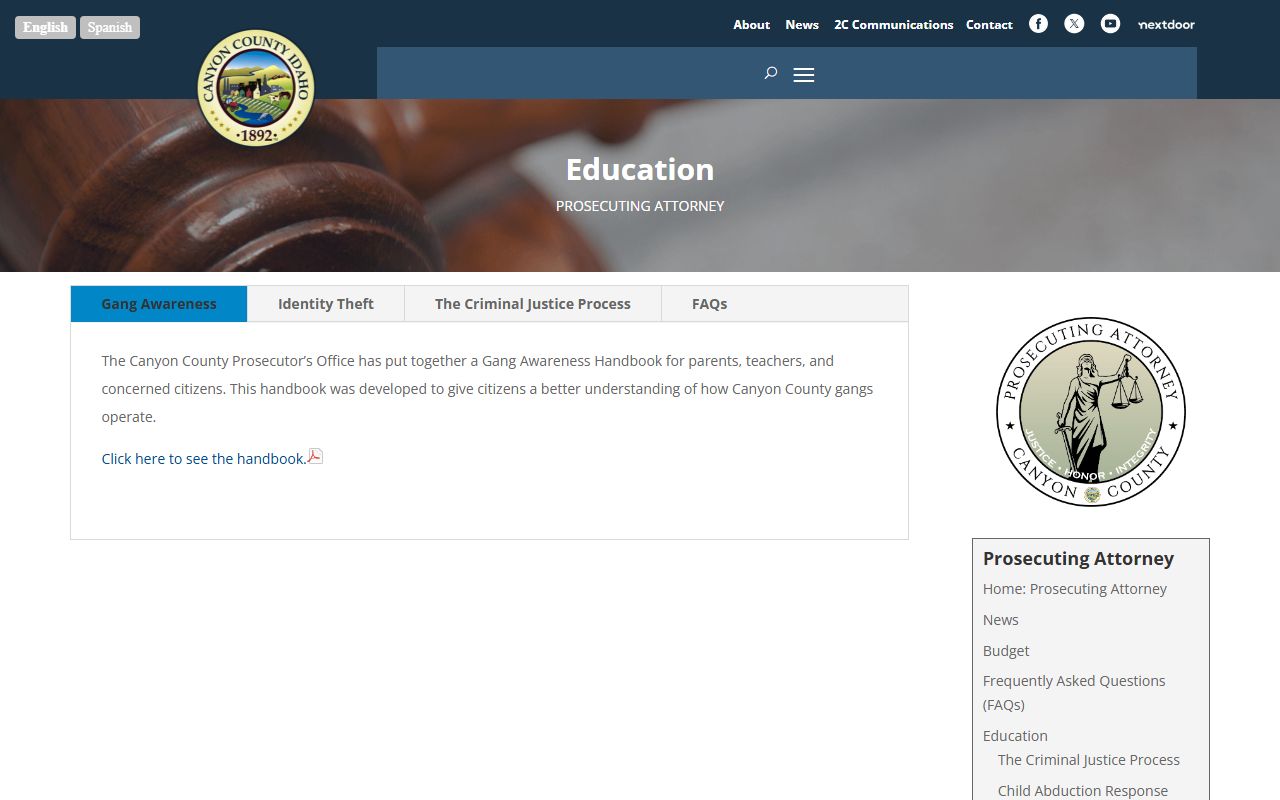
That source is the local bridge between the jail arrest and the court record because it explains charging, arraignment, hearings, plea options, trial, acquittal, conviction, and sentencing.
Search Canyon County Court Records After Arrest
The main public case-search tool is the Idaho iCourt Portal. Idaho iCourt public materials say Canyon County entered the system in Wave 1 on October 10, 2017. Basic public users do not need registration, while extended access requires approval. Public electronic court records are generally available for all Idaho counties from 1995 forward, and the court site aims for updates at least hourly during the working day.
- Use Current Arrests or the jail roster to confirm the person's name, arresting agency, arrest date if shown, and booking-charge wording.
- Open the Idaho iCourt Portal and use Smart Search.
- Enter a party name in the format Last, First, or search by case or record number if known.
- Use advanced filters to select Canyon County if the statewide results are too broad.
- Open the criminal case and review Charge Details, Bond Information, Other Events and Hearings, and Disposition Events.
- Compare the court charge list with the jail roster charge rows, keeping in mind that changes are normal.
The iCourt public tutorial shows Smart Search, hearing search, filter controls, wildcard searches, and result tiles. Source: Idaho iCourt public search tutorial.
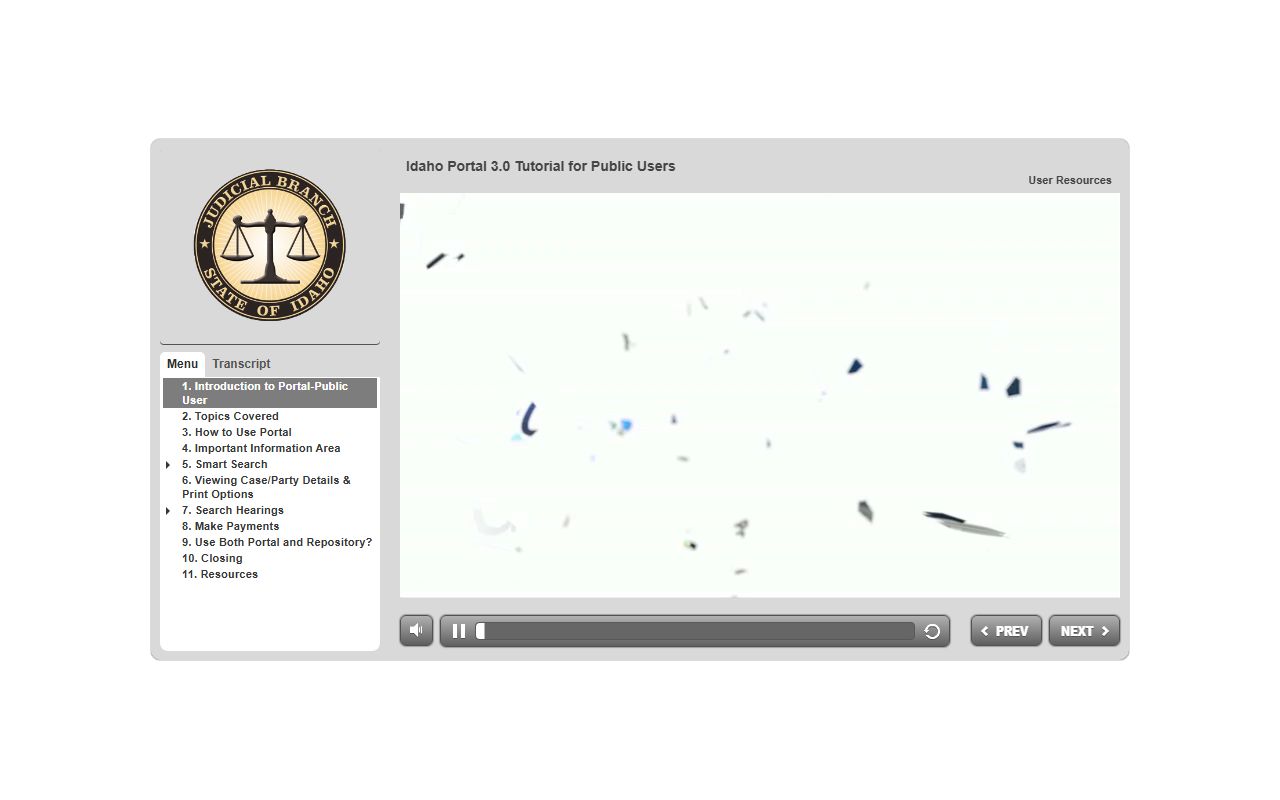
The tutorial matters for Canyon County court records after arrest because name format, county filters, wildcard rules, and case-detail tiles affect whether a public search finds the right case.
Canyon County Court Record Search Fields
iCourt offers more search controls than the jail roster. A public user can search by case or record number, party name, hearing data, business name, attorney information, or judicial officer, depending on the search path. The portal may remember filters, so clear old filters before assuming there are no Canyon County court records after a jail arrest.
| Field or Control | Type | Required | Notes |
|---|---|---|---|
| Smart Search entry | Text | Yes | Enter case or record number, or a party name. |
| Party name | Text format | For name search | Use Last, First; normal first-last order may fail. |
| Wildcard search | Text pattern | No | Use at least four letters plus an asterisk, such as Jones, T*. |
| Advanced Filtering Options | Filters | No | Select Canyon County instead of all counties if needed. |
| Search Hearings county | Dropdown | For hearing search | Choose the county where the case is located. |
| Hearing date range | Date fields | For hearing search | Use the date fields at the bottom of the hearing search flow. |
| Result controls | Dropdown and columns | n/a | Choose page size and sort or filter result columns. |
Canyon County Arrest Charging Documents
After a Canyon County jail arrest, the court record begins with a formal charging step. The prosecutor education page identifies two local routes: an official complaint filed by the Prosecuting Attorney's Office or a grand jury charging decision. Felony cases may include preliminary-hearing review, where the magistrate court decides whether enough evidence exists to send the case to district court.
| Document | Who Uses It | What It Does |
|---|---|---|
| Complaint | Prosecuting Attorney's Office | Starts or states the filed criminal charge in court. |
| Information | Prosecutor after court process | Often used to carry felony charges forward after probable-cause review. |
| Indictment | Grand jury | Charging decision based on evidence presented to a grand jury. |
These documents are not the same as the jail booking row. The booking row can be created before all court filing decisions are complete. That is why the Canyon County roster directs users to iCourt for current charge status.
Canyon County Arrest Charge Status
Charge status can change as a Canyon County case moves. A booking charge may be amended, reduced, dismissed, replaced, or carried forward. Court records after a jail arrest should be read by charge and by event date, not just by the first charge label seen on the roster.
| Status | Meaning in Court Records |
|---|---|
| Pending | The charge or case remains unresolved. |
| Amended | The prosecutor or court changed the charge wording or count. |
| Reduced | The charge severity was lowered through plea, amendment, or court action. |
| Dismissed | The charge ended without a conviction on that count. |
| Acquittal | A not-guilty result after trial. |
| Conviction | A guilty plea or finding followed by sentencing. |
| Bound over | A felony matter was sent from magistrate to district court after probable-cause review. |
Bond After a Canyon County Arrest
The Canyon County jail roster result inspected in the research did not show bond. Bond and release conditions are tied to court process, especially arraignment. The prosecutor page says arraignment is the suspect's first court appearance, where the person receives notice of charges, possible penalties, and conditions of release. The suspect may post bail at that time, or the judge may submit the suspect to pretrial release.
| Release Type | How It Works Locally |
|---|---|
| Cash bond | Money paid under court-set release conditions; confirm current amount through iCourt, clerk, or jail status line. |
| Surety bond | A bail agent may post if allowed by Idaho law and the court order. |
| Personal recognizance | Release based on promise and conditions rather than full cash payment. |
| Pretrial release | A supervised release option named in Canyon County materials and roster notice. |
| No-bond or hold | Custody continues due to a hold, warrant, parole or probation violation, civil contempt, or other authority. |
No official Canyon County source in the research listed accepted bond payment methods, bond-posting hours, or an online bond vendor. Do not rely on unsolicited phone calls demanding payment. Canyon County has warned about phone spoofing scams tied to missed court and warrant threats.
Warrants Before a Canyon County Arrest
No separate Canyon County sheriff active-warrant search portal was found in official public sources. iCourt Smart Search can be used for unsealed warrants or no-contact orders by record number, according to the public tutorial. If a warrant leads to booking, the person may appear on Current Arrests or the jail roster. For court-date questions, the detention FAQ says to call the Canyon County Clerk at 208-454-7571. For sheriff contact, use 208-454-7510 or non-emergency dispatch at 208-454-7531.
- Arrest warrant
- Court authority to take a person into custody for an alleged crime.
- Bench warrant
- A warrant often issued after failure to appear or violation of a court order.
- Fugitive hold
- A hold tied to another jurisdiction or court.
- Detainer
- A notice or request from another authority that can affect release.
Canyon County Charges vs Convictions
A Canyon County jail arrest and a Canyon County conviction are not the same. An arrest means a person was taken into custody. A charge means an allegation appears in booking or court records. A conviction requires a guilty plea, guilty finding, or comparable final result after court process. Public records may show each stage, so read the status and disposition carefully.
| Point of Comparison | Charge | Conviction |
|---|---|---|
| Stage | Accusation or filed count | Final guilty result on a count |
| Proof level | Probable cause or charging decision | Proof beyond reasonable doubt, plea, or accepted finding |
| Where it appears | Roster, Current Arrests, iCourt charge details | iCourt disposition or sentencing events |
| Meaning | Not proof of guilt | Formal court outcome |
Canyon County Sealed and Expunged Records
Public iCourt users may not see sealed cases or exempt information. Idaho public materials say sealed or exempt records may return no public result, and a valid requester may need to request records at the courthouse where the case is located. Idaho does not use every state's terminology the same way, so court relief should be read through Idaho law and the actual order in the case.
| Issue | Sealed | Expunged or Set Aside |
|---|---|---|
| Public visibility | Hidden or restricted from ordinary public access. | Depends on Idaho law and the order entered. |
| Where to check | iCourt, clerk, and the court order. | Court record, clerk, and Idaho Code 19-2604 where relevant. |
| Jail record effect | May not automatically remove all booking references. | Does not automatically erase every official or third-party copy. |
Idaho Code 19-2604 is the practical post-case relief statute noted in the research for dismissal or setting aside after probation in qualifying cases.
Restricted Canyon County Arrest Records
Idaho public access law starts with openness, but law-enforcement and court records can be withheld or redacted. Idaho Code 74-102 creates the public-record access rule, and Idaho Code 74-124 protects investigatory records when release would cause listed harms. Juvenile records, active investigations, confidential identifiers, victim and witness information, sealed cases, and discovery in pending cases may have limits.
Important: Court, arrest, and custody records are not consumer reports and should not be used for FCRA-covered decisions.